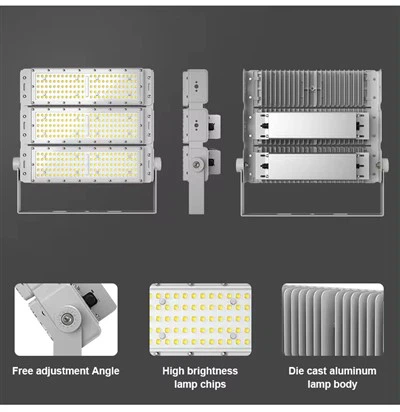
Modular floodlights are innovative lighting fixtures. To simplify disassembly and replacement, the fixture's optical system (light source + lens), power supply, and heat dissipation housing are integrated into standard modules. Like a "modular mobile phone", users can combine, upgrade, or repair individual modules instead of replacing the whole device.

| 1000W | |
| 240VAC | |
| 60/90 | |
| Die-cast aluminium | |
| 50,000 | |
| 1000W | |
| 130000 lm |




Professional sports venues: football fields, basketball courts, tennis courts, badminton courts, baseball fields, swimming pools, etc.
School and community sports fields.
Outdoor square: Also serves as a venue for public cultural and sports activities.


A: Absolutely! This is one of its core advantages. Basic dimming: Through protocols such as 0-10V and DALI, the brightness can be remotely adjusted to achieve energy savings and the switching between different scenarios (such as training mode, competition mode, and clearance mode). Advanced Control: Through DMX512 or network protocols (such as Art-Net), dynamic color changes (applicable to RGBW lamps), flashing, chasing and other effects can be achieved, which can be used for opening ceremonies, intermission performances, etc. Intelligent system: Can be connected to the Internet of Things platform and, in combination with sensors, achieve on-demand lighting, remote monitoring, fault alarm and energy management.
A: Because LED sports lights are high-tech and high-value-added products. Their costs include not only the LED chips, but also: Efficient heat dissipation structure (such as cast aluminum heat sink, heat pipe) Precision optical system (aspheric lenses, reflector cups) High-quality power supply (guaranteeing stability and long lifespan) Sturdy shell and anti-corrosion treatment However, from the perspective of the entire life cycle cost, LED lamps have lower overall ownership costs compared to traditional lamps due to their energy-saving properties, long lifespan, and extremely low maintenance costs.